

Who Is Liable When You’re Injured at a Private Event or Party?
Click For Free Consultation
Legally Reviewed By: Robert M. Knowles
Attorney & Partner At Knowles Law Firm
Getting hurt at a friend’s backyard cookout, a neighborhood gathering, or a private celebration raises a question most people never expect to face: Can you actually hold someone responsible? The answer in Nebraska depends on the circumstances of the injury, who hosted the event, and whether the property or the host’s conduct played a role in causing the harm. In many cases, the answer is yes.
At Knowles Law Firm, we are a family-owned firm with over 55 years of experience helping injured Nebraskans recover compensation from all types of negligent parties. The lawyers at Knowles Law Firm handle premises liability cases involving private properties, events, and social gatherings across Nebraska, and we work on a contingency fee basis, so there is no upfront cost to pursue your claim.
Can a Homeowner Be Liable for Injuries at Their Party?
Yes, a homeowner or property owner may be liable when a guest is injured at a private event. Nebraska law requires property owners to maintain reasonably safe conditions for invited guests. When a dangerous condition on the property causes injury, and the host knew or should have known about it, the host may face legal responsibility.
Common hazards at private events include unstable deck structures, unmarked steps or drop-offs, poor outdoor lighting, slippery pool areas, and defective rental equipment. The same duty of care that applies to injuries in public places also extends to invited guests on private property. An injury caused by a hazard the host created, ignored, or failed to warn guests about can form the basis of a valid premises liability claim.
What About Injuries Involving Alcohol at a Private Event?
Alcohol-related injuries at private parties introduce a separate layer of liability under Nebraska law. Under Nebraska Revised Statute § 53-403, a “social host” is defined as a person who knowingly allows a minor to consume alcohol in their home or on property under their control. When a minor is injured or causes injury to another person as a result of consuming alcohol at a private gathering, the host who supplied or permitted that alcohol may be held liable.
It is important to understand the scope of this law. Nebraska’s social host liability statute applies specifically when the intoxicated person is a minor. If an adult guest becomes intoxicated and injures someone, the liability analysis shifts to general negligence principles rather than the dram shop framework. This distinction matters significantly when evaluating who may be liable for injuries on private property and what legal theories may apply to your situation.
Does Comparative Negligence Affect a Private Event Injury Claim?
Nebraska’s comparative negligence system can come into play in private event injury claims in ways that are unique to the social setting. Unlike a commercial property, where hazards are more clearly the business’s responsibility to address, a private-party environment often involves personal relationships, informal spaces, and conditions that guests may have some awareness of beforehand. If you were injured on a broken deck railing at a friend’s home that you had visited before, a court may consider whether you had prior knowledge of the hazard.
Your own actions at the time of the event also factor into any claim. Whether you were wearing appropriate footwear for the terrain, whether you were made aware of a known hazard, and whether you took reasonable steps to avoid the danger can all affect how fault is apportioned. Under Nebraska law, you may still recover compensation even if you are partially at fault, as long as your share of fault does not exceed 50 percent.
What Compensation May Be Available After a Private Event Injury?
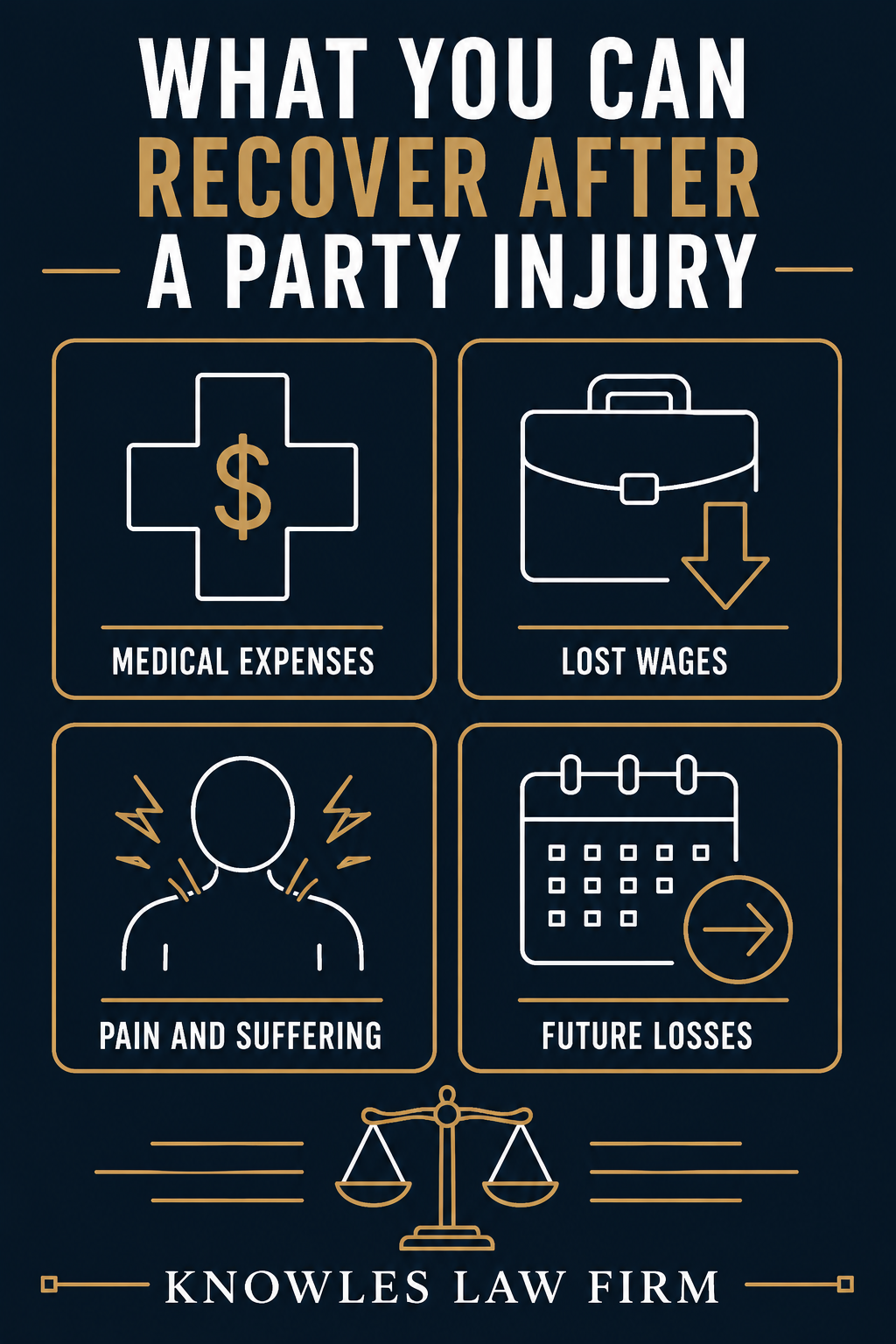
Victims injured at private events in Nebraska may be entitled to compensation for medical expenses, lost wages, reduced future earning capacity, and pain and suffering. How Nebraska courts calculate pain and suffering depends on factors such as the severity of the injury, the length of recovery, and the injury’s impact on daily life. The specific facts of your case, including the nature of the hazard and the host’s level of awareness, will shape what compensation you may be able to pursue.
The following categories of damages are commonly sought in private event injury claims:
- Medical expenses: Compensation for all costs related to emergency treatment, surgery, physical therapy, and ongoing care.
- Lost wages: Recovery for income you were unable to earn while injured and recovering.
- Pain and suffering: Damages reflecting the physical harm and impact on your daily activities caused by the injury.
- Future losses: Compensation for long-term medical costs or reduced earning ability resulting from a permanent or serious injury.
Every private event injury claim is different, and the value of yours depends on the specific facts, the severity of your injuries, and how clearly liability can be established.
Contact Knowles Law Firm After a Private Event Injury in Nebraska
Knowles Law Firm has recovered multi-million dollar results for injured Nebraskans across a wide range of personal injury cases, including premises liability claims involving private properties and events. As a family-owned firm with over 55 years of experience, every attorney here has a personal stake in the outcome of your case and a deep commitment to the clients we serve.If you were hurt at a private party, backyard event, or social gathering in Omaha, Lincoln, Bellevue, Papillion, or anywhere else in Nebraska, we may be able to help you pursue the compensation you deserve. Contact our team today to schedule a free consultation.
About Our Attorney
Robert M. Knowles
Attorney & Partner at Knowles Law Firm
Robert has tried cases in both state and federal courts and was selected as one of the top 100 litigation lawyers in Nebraska for 2014 by the American Society of Legal Advocates. Less than 1.5 percent of lawyers nationally are selected for this recognition. He is rated AV by Martindale-Hubbell which is the highest rating an attorney can obtain. He was also selected by Martindale-Hubbell as a 2019 Top Rated Lawyer.

 Menu
Menu
